Tuesday, 30 January 2007

cAMP fixed

Yesterday I just had the calculation running to keep me entertained while I was studying for biochemistry. I guess I shouldn't have posted the picture without checking it right away. Here's the redone version. The structure was optimised with semiempirical quantum mechanics (PM3) in Arguslab.


What was wrong?

The nitrogens should not have hydrogens bonded to them. It is a problem with the delocalised bonds. If you separate them into single and double bonds the situation would be obvious. I needed the resonance structures for molecular mechanics, in order for all bonds to be the same length.

A hydrogen was missing at the 5'-C, no idea why.

The third thing I think was wrong is the amino nitrogen. It may have been too pyramidal because classical MM can't properly include conjugation effects. I don't know if it should be all the way planar or a little bit bent. The structure depends on the semiempirical method used (AM1 makes it planar, PM3 and MNDO bent). I guess I would need an ab initio calculation to do that. But I don't have a computer program and I don't have 64 parallel chips working for me. Í have to ask my professor if I can get access to our school's Gaussian. That would be amazing. But I don't know if it would work. Another problem is that I modelled an isolated gasphase molecule at absolute zero (something you don't have a lot in real life).

Monday, 29 January 2007

What's wrong with this molecule?

This should be cAMP but please don't take the pictures serious. I don't know what I was thinking when I made them. It looks aweful. I am sorry. There are three bad mistakes in there.

Do you find what's wrong with the molecule? There are two mistakes with the constitution and a geometrical one.

The nice thing about it is that it shows again that you do need some chemical understanding even if you become a theorist. So my life won't consist only of typing in numbers if I will go into that direction.


If you want to know something about cAMP, here you go:

This molecule is derived from the last one if you let the 3'-OH group of ribose attack the first phosphorous atom. This is done inside cells by an enzyme appropriately called adenylate cyclase. Adenylate cyclase is activated by the α-subunit of a G protein that received a GTP group after the initial messenger bonded to an adrenergic receptor.

That sounds like a pretty complex mechanism but it gets longer. Cyclic AMP does not work by itself. In a next step it activates an enzyme called protein kinase A. This enzyme will phosphorylate other enzymes thereby activating them. That will finally have an effect on the metabolism.

Since cAMP is a second messenger of adrenaline it activates enzymes associated with it. They involve glycogen breakdown and fatty acid mobilisation. In general it will activate the organism.

Caffeine which has a similar structure works by inhibiting the phosphodiesterase that breaks down cAMP to AMP. After taking in caffeine, cAMP will stay in the cells longer and its stimulating effect is amplified.

These images were again calculated with UFF in ArgusLab. UFF is a simple fast force field method that normally produces good results (unless the person using it messes it up).

Monday, 22 January 2007

ATP

I have been kind of busy these days. But there is always some time to play with graphics. Today's molecule is ATP. It's the body's immediate energy source. It works as a cofactor in many enzymes of different kinds. It is also a building block of RNA.

The active part is a double phosphoric acid anhydride. This is an instable "high energy" bond. The hydrolisation to ADP and phosphate has a biological standard free energy of -35 kJ/mol. It is used coupled with endergonic reactions. You can compare the reaction to the hydrolisation of P4O10[1].

Besides the two energetic bonds you have ribose and adenine forming a "handle".


In physiological conditions ATP can form a complex with Mg2+. This stabilises the negative charges on the oxygen atoms.


The structures were calculated in ArgusLab using the Universal Force Field method. The images were drawn in PyMOL with the ray function.


[1] Don't call it P2O5 unless glucose is H2CO for you.

Wednesday, 17 January 2007

Protein image

I am sorry, there is no real post either today. Just something to look at. This is the demo protein from PyMOL. You can see the α-helices and the β-sheets. In between you have loops, areas with no ordered secondary structure. These loops make the protein more hydrophilic because O and N can form hydrogen bonds to water when they are not bonded to each other. The active sites are mostly contained in loops because they are easier accessible. Loops are also the places where most mutations occur. Mutations in α-helices or β-sheets may mess up the structure but mutations in loops can stay because there is no structure to mess up [1].


As Mike said, the situation is not quite as easy because there is much more than helices and sheets making up a protein's structure.

Monday, 15 January 2007

Dinosaur comics

After reading about dinosaur comics at The Disgruntled Chemist I have to show you my favourite one: Link. That does bother me sometimes: How are you supposed to become a zombie when a zombie has already eaten your brain?

Friday, 12 January 2007

Nitrogen MOs

Theory is nice. Not only because it helps for understanding things but also because some of the proofs are really elegant. Today it won't be theory, though. Just a few images.

These are the LCAO molecular orbitals of dinitrogen. You can get a qualitative result from correlation diagrams. For getting the exact form of the σ-orbitals, you need a Hartree-Fock calculation.

The 2px and 2py orbitals are each in their separate irreducible representations. The corresponding π-MOs are formed by addition for the bonding ones and subtraction for the antibonding ones.

The 2s and 2pz orbitals are able to interact with each other. So the situation is not quite as easy and you have four orbitals made up of all of them. The two lower ones are mostly s orbitals, the two higher ones mostly p. You can see the hybridisation numbers underneath those orbitals.

The only thing that you wouldn't have guessed is the place of the second σg-orbital. In a correlation diagram you would think of it as the bonding p-σ-MO. Because overlap is bigger it would be lower than the bonding p-π-MO. But it isn't. The reason is that we also have s mixing in. A little bit p stabilises the lower orbitals, a little bit of s destabilises this one. The orbital is made of two sp3-hybrids pointing away from each other only overlapping with their smaller parts.

σu
sp5.4
πuπu
σg
sp3.4
πgπg
σu
sp.18σg
sp.30

Wednesday, 10 January 2007

QM tutorial (1)

The first goal will be to point out that quantum mechanics can be a clean science [1]. I will try to show the similarities between the space we are used to and the vector space of wave functions (or any other mathematical vector space). It is often helpful to compare wave functions and their linear combinations to classical vectors in our 3D world.

A mathematician would tell you that a vector space is a commutative group (whose elements are called vectors) combined with a field (whose elements are called scalars) where a few natural axioms apply. You don't need to know the exact definition but you have to keep in mind that it is a very broad definition that works in many different cases.

You can add and subtract vectors and you can multiply them with scalars. If you do both at the same time it's called a linear combination. If b1, ..., bn are n vectors and x1, ..., xn. Then the vector a = x1b1 + ... + xnbn is called a linear combination of them [2].

Two examples:
  • Pick an origin on a piece of paper and draw two vectors (that are not going into the same direction). Then you will be able to reach every spot on your paper by adding (or subtracting) multiples of those vectors to each other.

  • Take and s orbital and a p orbital and combine them to spn hybrids. You can see that here.

    You can apply a function to vector and make a different vector out of it. An important case is that of a linear function (or linear transformation). f is a linear transformation if f(xa + yb) = xf(a) + yf(b). In finite spaces linear transformations can be represented by matrices.

    For example symmetry operations are linear transformations [3]. The most important linear transformation for a chemist is the Hamilton operator [4]. Pretty much every operator a theoretical chemist uses is linear. When dealing with vector spaces of functions [5] people like to say linear operator instead of linear transformations but it is the same. For example eigenvalue theory is alike. Then it does not surprise us that the Schrödinger equation can be reduced to a matrix eigenvalue problem according to the Ritz method or Hückel method.


    [1] By "clean" I mean avoiding calculus. Calculus may be useful but it seems like a witchcraft to me.

    [2] Vectors are bold, scalars are italic. You could write vectors with little arrows but it gives the wrong impression.

    [3] A special kind called unitarian but you need a scalar product to say that and that's not today's topic.

    [4] Another special kind called hermitian, you need a scalar product again.

    [5] The word function is very ambiguous since everything we are dealing here is function. Even a tuple (which is normally called vector by physicists or chemists) is a function. So we should specify that we are talking about functions whose domain are the real numbers.
  • Monday, 8 January 2007

    Some more of benzene's MOs

    I am not starting my QM tutorial quite yet. Today's post is mostly about graphics to look at. You can see the 6 canonical molecular orbitals with lowest energy.


    Actually today's post was just for showing those graphics but I will talk a little bit about them.

    First you notice that they look a little bit like the π-MOs. This is because of symmetry. You have two dimensional irreducible representations again.

    Adding up orbitals and electrons tells you that there are 30 orbitals, 15 of them populated with two electrons. 6 are seen here, 6 are not shown, and the π-MOs (3 of them populated) are shown in the last post.

    This time the situation is not quite as easy as with the π-MOs because every carbon has 3 orbitals in the plane (s, px, py) and every hydrogen one. You can combine them to 24 different σ-MOs. You can see that the first one is mostly carbon's s (the lowest energy orbital in the system). The 6th is mostly made of hydrogen s AOs.

    The MOs shown are canonical, meaning they are delocalised irreducible representations of the symmetry group. You could take the 12 populated canonical σ-MOs and rearrange them to two 6 dimensional reducible representations. One of them being only C-C σ-bonds the other one C-H σ-bonds. The electron density, the only physically relevant variable, would not change. It does not matter into which MOs you divide it.

    It would not be possible to arrange the three populated π-MOs to localised bonds. This again is something a chemist is familiar with.

    Sunday, 7 January 2007

    Benzene's MOs

    I am planning to take a few posts for covering the principles of quantum mechanics (with a slight mathematical touch). Today's post is some kind of introduction to get your attention (or tell you that you won't have to check this blog for the next days). I am going to outline the principles of MO theory on the example of benzene.

    The images show a cross section through the π-MOs of benzene 75 pm above the molecules plane. When you look at them you have to consider that the wave function changes it's sign if you move to the other side of the plane.

    The MOs were calculated according to the Hückel-theory. The approximation in this case is very good. There is no other possible way for LCAO because of symmetry considerations. The character table for the group D6h can be seen here.


    b1g


    e1u

    e1u

    e2g

    e2g

    a2u


    The molecular orbitals are arranged according to their energy. The three lower ones are populated with two electrons each. The first striking observation you make is that the energy scheme is a hexagon just like the molecule. This is actually true for all annullenes and the basis of Hückel's rule. I will talk about that later.

    The next thing you notice is that you get an extra nodal plane each time you move up a step. This can be understood with the fact that wave functions have to be orthogonal. In general the energy is higher the more nodal planes you have. The first explanation would be that nodal planes mean more curvature and more curvature means higher kinetic energy. This is actually not true because this would violate the virial law, stating that
    -T = V/2 = E
    (T ... kinetic energy, V ... potential energy, E ... resulting energy, E = T + V).
    The virial law states that higher kinetic energy corresponds to lower energy (just like a satellite travelling close to the earth will need high kinetic energy not to crash). In fact the orbitals are contracted but you don't get that from LCAO.

    The next thing to consider is that each set of degenerate orbitals has to be a representation of the symmetry group. For non degenerate orbitals this means that they have to comply with all symmetry operations (real orbitals are symmetrical or antisymmetrical). For degenerate orbitals it means that you don't leave the subvectorspace when you apply a symmetry operator.

    Any linear combination of degenerate orbitals is an orbital with the same energy eigenvalue. Therefore any orthogonal set of orbitals can be chosen to represent the eigenvalue. It makes sense to use the most symmetrical orbitals. For degenerate orbitals it is only possible that they comply with any commutative subgroup of the molecules symmetry group. In this case this is D2h. C6h would be commutative, too. But it has complex eigenvectors.

    Maybe that was too much already for an easy reading blog. It just amazes me how much you know from a little bit of symmetry group theory and linear algebra without having solved any differential equation.

    Friday, 5 January 2007

    Morphine

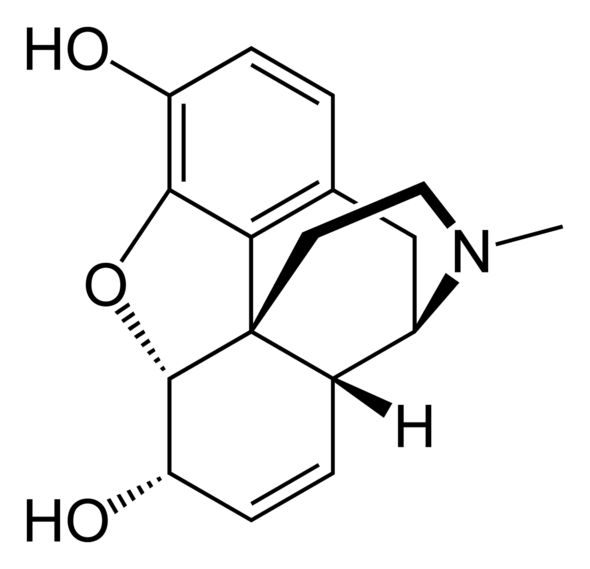
    Morphine acts by imitating endorphins (which is an abbreviation for endomorphines[1]). It binds to endorphin-receptors, therefore causing pain relief. Its narcotic action gave it its name after Morpheus the greek god of dreams.

    If you make a methylester out of the top OH you get codeine with antianalgesic, antitussive and antidiarrheal properties. Adding acetyl to both OH's gives the lipophilic form heroin, a highly addictive drug.


    Morphine's structure is fairly complex. You have three condensed rings, an oxygen bridge and a nitrogen bridge. Before you scroll down you can try to guess its structure. Which rings are in the same plane? The key is to consider that the c-hexene ring is annexed in a cis configuration.


    The benzene and c-hexane rings and the oxygen bridge are in the same plane. The c-hexene ring and nitrogen bridge are in a plane perpendicular to it.


    The ring seen on top might resemble the terminal tyrosine of β-endorphin. Besides that the structure does not really look like the 31 amino acid peptide.


    [1] You save o, m, and e. But it is arguable which o is taken out.


    I finally found out how I can use javascript in blogspot. This is an interactive model of morphine produced with the help of jmol. Change the view with left and middle mouse buttons. Use right click for options.

    Well, jmol does not work anymore on my blog. But since so many people seem to be looking at this post, I'll try TwirlyMol. And if even that does not load, click here.

    Thursday, 4 January 2007

    Icy

    We did not have much snow where I was on vacation but there were really nice ice crystals.


    I guess the crystals were formed like rime. Deposition of water vapour at night when the equilibrium pressure of water vapour drops because the temperature is lower. On the next image you see one of the crystals on my finger. You notice the lines that are probably just like growth rings, indicating the ice that was added every day.


    Ice Ih which is stable at ambient conditions crystalises in the hexagonal system. This can be seen here.


    The most notable property of ice is that its density is lower than that of cold water. This is caused by the fact that empty spaces remain when the molecules are arranged to form ideal hydrogen bonds. The fact that ice is losely packed makes it plausible that its structure will change when pressure is applied to it. That is why there are so many high pressure modifications of ice. You can find the phase diagram and much more information here.

    The structure stable at ambient conditions is called Ih. It crystalises in a hexagonal system. If you cool it down to about 170 K you change from hexagonal to cubic, the structure is called Ic. An important property of those two structures is proton disorder. Each oxygen has to have two short covalent bonds and two long H-bonds. In ice I modifications hydrogen atoms can be randomly arranged. This results in a fairly large remaining entropy at absolute zero (3.5 J mol-1 K-1).

    Below 70 K ice XI is stable. It is like Ih only that all hydrogens are ordered. At low temperatures entropy is not important any more and a slight difference in enthalpy might come into play.

    Ice II is formed at 198 K and 300 MPa. It may be the main component of icy moons. It has no proton disorder. Because of that you notice an entropy change of -3.22 J mol-1 K-1 when transforming ice Ih into ice II.

    Ice III and ice IX are corresponding structures where ice III has proton disorder and ice IX doesn't. Ice IX is stable at much lower temperatures. The reason is the same as with ice I and ice XI.

    Ice VII is stable above 3 GPa it is in equilibrium with supercritical water. Ice X at 100 GPa does not differentiate between covalent and hydrogen bonds.

    I picked out what sounded interesting to me. For more information check out (http://www.lsbu.ac.uk/water/).

    Wednesday, 3 January 2007

    I'll be back

    That's what pretty much every American had me say while I was there. I hope you are happy now.

    It's too late for me to write some more today. But tomorrow I will.